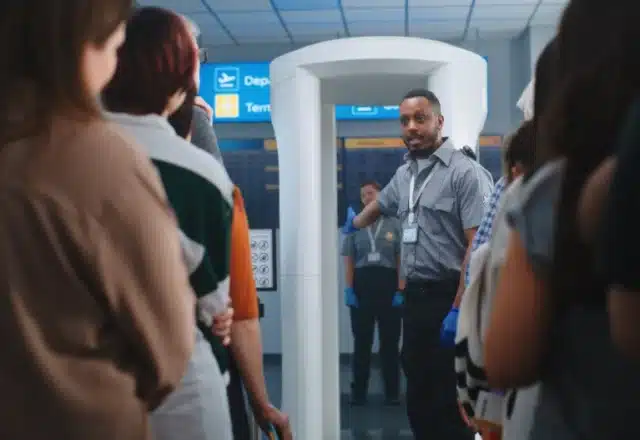

TSA Lines Are a Business Cost, Not Just a Travel Hassle
TL;DR: While TSA wait times are often treated as a routine inconvenience, they represent a measurable drain on productivity and performance. For business travelers, the real cost isn’t the line—it’s lost time, disrupted schedules, and missed opportunities:
- Business travelers lose 2–3+ hours per trip to TSA and airport buffers
- Airport wait times at the TSA create planning inefficiencies and schedule distortion
- TSA environments limit meaningful work, even during “working” travel time
- The true cost of TSA wait times often exceeds airfare when productivity is considered
- Growing demand for alternatives reflects a shift toward time optimization
You probably are already well aware that commercial air travel is usually less expensive than private aviation on a pure price basis. But if you’re an executive or top-level revenue-generating professional, you also already know that price is only one part of the equation.
When airport friction starts affecting schedules, decision-making, or high-value meetings, the productivity cost becomes much harder to ignore.
Does Business Travel Count as Working Time?
While questions like “Does business travel count as working time?” often come up, the answer is not always entirely straightforward.
Under U.S. Department of Labor guidance, whether travel time is considered compensable depends on factors such as timing, role classification, and whether work is being actively performed. For many salaried executives and senior professionals, the pragmatic distinction becomes less about legal classification, however, and more about availability and accountability.
Time spent in transit is time potentially lost to:
- Responding to urgent requests
- Preparing for meetings
- Managing teams or client communications
That’s where TSA wait times become particularly inefficient. From responding to a board-level request to preparing a time-sensitive announcement or reviewing confidential materials, there are many time-sensitive and mission-critical tasks that are simply not suited to crowded, unpredictable TSA environments, especially when public Wi-Fi introduces security concerns and mobile hotspots, while more secure are often unreliable.
TSA Wait Times and the Hidden Cost of Lost Productivity
One of the most persistent inefficiencies in commercial travel remains TSA wait times. While often viewed as routine, they create consistent, unrecoverable productivity loss.
Commercial flights require early arrival—typically 90 to 180 minutes—driven largely by unpredictable wait times for TSA clearance.
During disruptions in early 2026, delays became so extreme that some travelers paid others to stand in line for them.
Meanwhile, as AOL reports, TSA delays have resulted in charter company bookings jumping as much as 39%. The key takeaway? The true cost of TSA clearance isn’t the checkpoint; it’s the opportunity cost of lost time. And this data proves that solo travelers and business travelers alike are beginning to awaken to the immense value in private aviation when it comes to enabling uninterrupted productivity.
For the Ultimate in Convenience & Productivity, Choose Stratos Jets
The most effective business travelers don’t just manage time; they protect it.
Stratos Jets delivers a smarter approach to private aviation, combining on-demand flexibility with intelligent flight matching, transparent pricing, and uncompromising operational standards. Because when the stakes are higher, your travel strategy should be more strategic.
Interested in making the switch to private aviation? Use our private jet cost estimator now.
Alternatively, explore our charter membership options here.









Are you ready to book your Istanbul to Ankara charter flight yet?
Our friendly, expert air charter agents are here to answer questions or start your quote today. Don`t wait, call now and we'll get you on your way to your destination!
Call 888-478-7286